Ananda has co-led Jua’s EUR 10 million Series A funding round alongside Future Energy Ventures, with continued support from existing investors including 468 Capital, Promus Ventures, and others.
Jua is a Swiss startup building the world’s first purely AI-driven Earth Intelligence Platform for operational weather and energy forecasting.
Founded by weather and machine learning expert Marvin Gabler, Jua is redefining weather forecasting. Unlike traditional models that rely on rule-based simulations, Jua’s Model learns the laws of physics directly from data, delivering faster, more scalable, and higher-resolution forecasts. This helps the energy sector by optimising renewable output, stabilising grids, and improving market efficiency, paving the way for a more resilient, cost-effective, and sustainable energy system.
The Weather Challenge in Renewable Energy
The energy landscape is undergoing a fundamental shift. From industrial production to transportation, electrification is the cornerstone of global decarbonisation efforts, and demand for clean electricity is going to rise continuously.
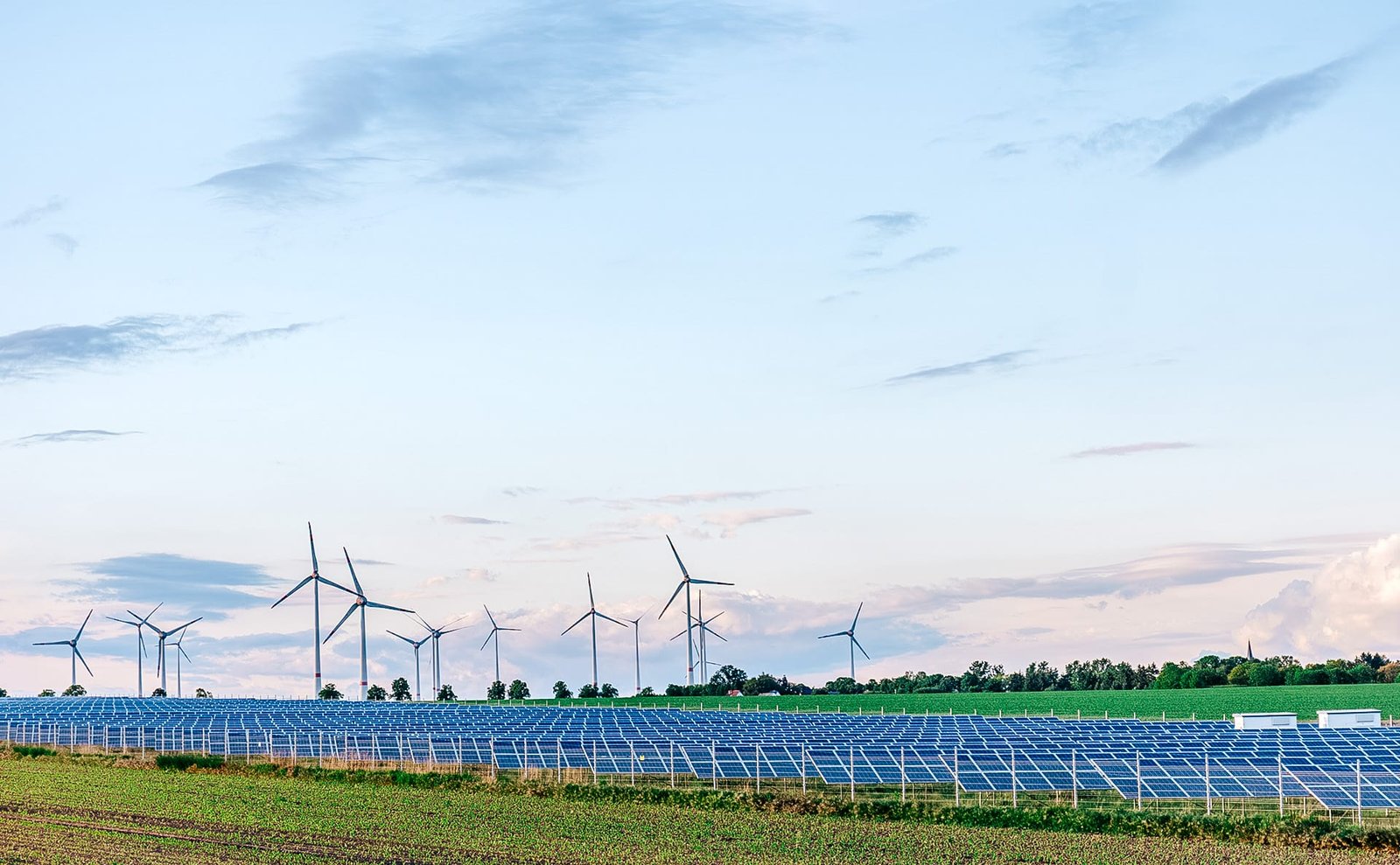
Yet, the technologies driving this transition — wind and solar power — are inherently weather-dependent. Unlike fossil fuel plants, which can ramp up production on demand, renewables generate electricity only when the wind blows or the sun shines. This introduces a new level of uncertainty into energy markets, where supply no longer depends on human control but on atmospheric conditions.
Examples include the stormy spring in 2022, when prolonged strong winds drove record wind power generation in Europe, creating surpluses and lowering prices, and December 2024, when extended low wind and solar output led to high prices and supply constraints. These events highlight the challenge of integrating renewables into a grid designed for steady, controllable power. As weather increasingly shapes energy availability, managing these fluctuations is crucial for grid stability and market efficiency.
Grid operators and energy traders face growing challenges in managing supply fluctuations. Without precise forecasts of when and where wind and solar power will be available, balancing the grid becomes more complex, increasing reliance on backup fossil fuel plants and driving up costs. Uncertainty in energy availability leads to price volatility, operational inefficiencies, and, ultimately slower adoption of renewables.
Accurate weather forecasting is now as essential as power generation itself. However, traditional forecasting models — based on physics-driven simulations — are slow, resource-intensive, and often lack the resolution needed for real-time energy market decisions. A more advanced approach is required.
Jua is providing that solution.
Jua’s Breakthrough: A New Approach to Weather Forecasting
By replacing conventional weather models with a purely AI-driven forecasting system, Jua enables faster, more precise, and scalable predictions. With improved insights into weather-driven energy fluctuations, Jua is helping to stabilize grids, enhance market efficiency, and make renewables more predictable — supporting a more reliable and cost-effective energy transition.
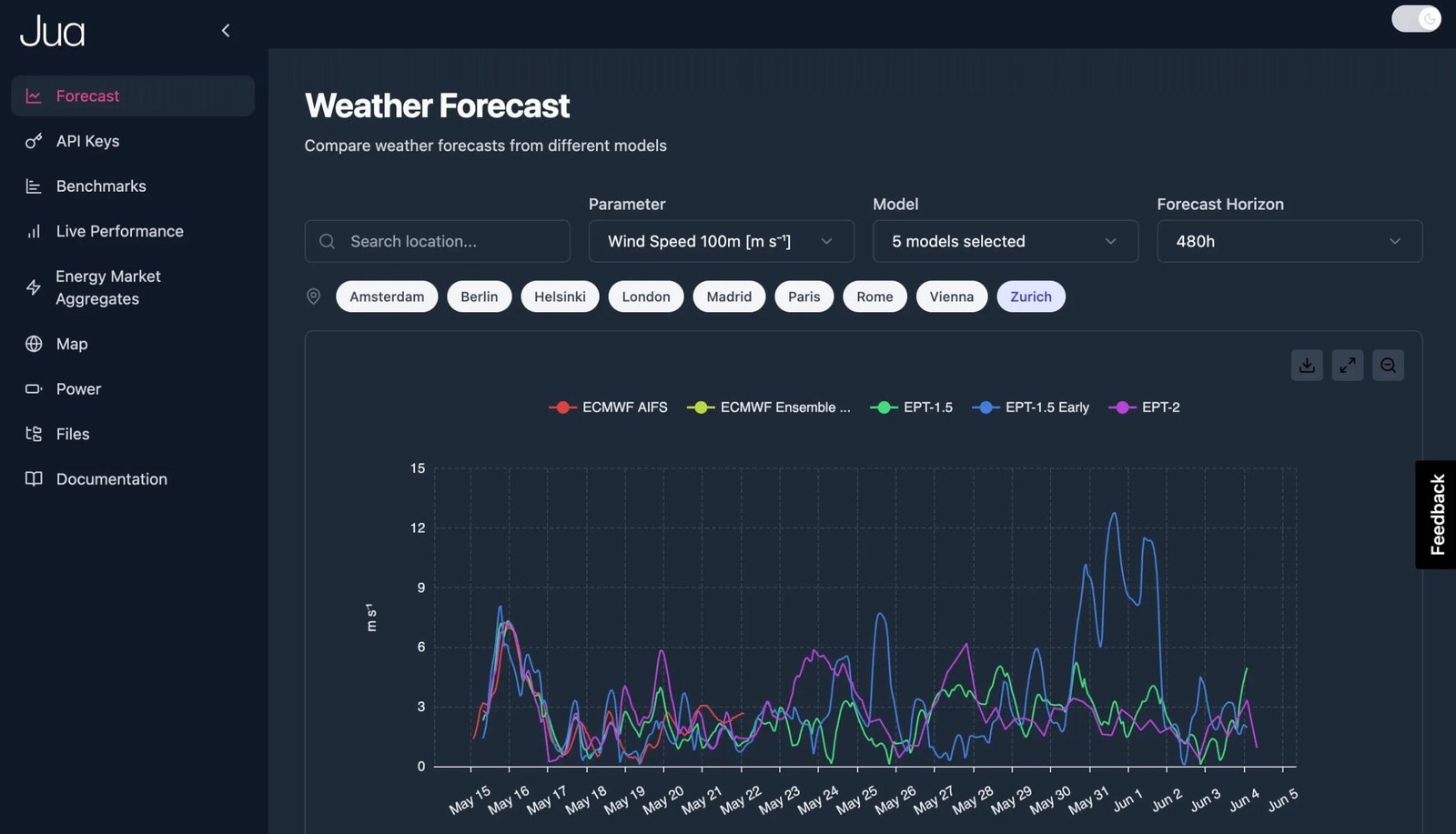
At the core of this breakthrough is the Foundation Physics Model (FPM) — an AI system that learns the fundamental rules of weather and climate directly from real-world data, rather than relying on pre-programmed equations. Traditional models require solving complex physical equations at every time step, which is computationally intensive and limits both speed and resolution. Jua’s approach bypasses these constraints by using AI to recognise patterns and predict weather more efficiently. This allows Jua to generate high-resolution forecasts faster and more frequently, providing a crucial advantage for industries that rely on accurate, real-time weather insights.
Jua’s latest model, EPT-2, has already demonstrated significant accuracy gains, especially in energy-relevant areas. Upcoming models will take this further with unprecedented resolution and forecasting range, setting a new benchmark for the field.
This shift is more than an incremental improvement — it represents a fundamental rethink of how weather can be predicted, opening the door to breakthroughs in climate modeling, extreme weather prediction, and geophysical sciences. Jua isn’t just making forecasts better; it’s redefining the entire approach to understanding the atmosphere.
A Stellar Team
Jua’s founder and CEO, Marvin Gabler, previously led R&D at his family’s meteorology firm. Frustrated by the slow pace of innovation in meteorology, he started Jua to redefine weather science from the ground up. The exceptional performance of Jua’s weather model places him at the forefront of his field.

The broader team is equally impressive: the company consistently attracts top talent, successfully competing with tech giants like Google and DeepMind for AI talent. This success reflects not only a commitment to scientific excellence but also a strong emphasis on fostering an entrepreneurial spirit.
Jua and Ananda
The transition to renewable energy is central to building a more sustainable world, but its success depends on solving the challenge of weather-driven energy variability. At Ananda, we invest in breakthrough technologies that tackle systemic challenges, and Jua’s AI-driven approach to weather forecasting aligns perfectly with this mission.
Jua’s work complements our existing energy and climate innovation investments, such as Decade and EcoG. With Jua, we see a company not only improving forecasting for today’s energy markets but also laying the groundwork for a greener, more resilient, data-driven energy system.
“Weather prediction has long been a limiting factor in renewable energy adoption. By supporting Jua, we are backing a solution that removes uncertainty from energy markets, strengthens grid stability, and enables a smarter, faster green energy transition.” — Florian Erber, Founder and General Partner at Ananda Impact Ventures
The Broader Impact: Enabling Smarter Decisions Across Industries
Beyond the energy sector, Jua’s AI-powered weather forecasting has the potential to transform industries such as logistics, agriculture, and insurance. As the technology advances, more accurate predictions will help mitigate risks, optimise operations, and reduce costs, making businesses more resilient to weather-driven disruptions.
In the future, Jua’s models could safeguard supply chains against extreme weather, improve crop yield forecasting, and enhance insurer risk assessment. As climate volatility increases, investing in advanced forecasting will become essential. AI-powered weather models like Jua’s are expected to not only accelerate the transition to renewable energy but also equip industries worldwide with the insights needed to navigate an increasingly unpredictable future.