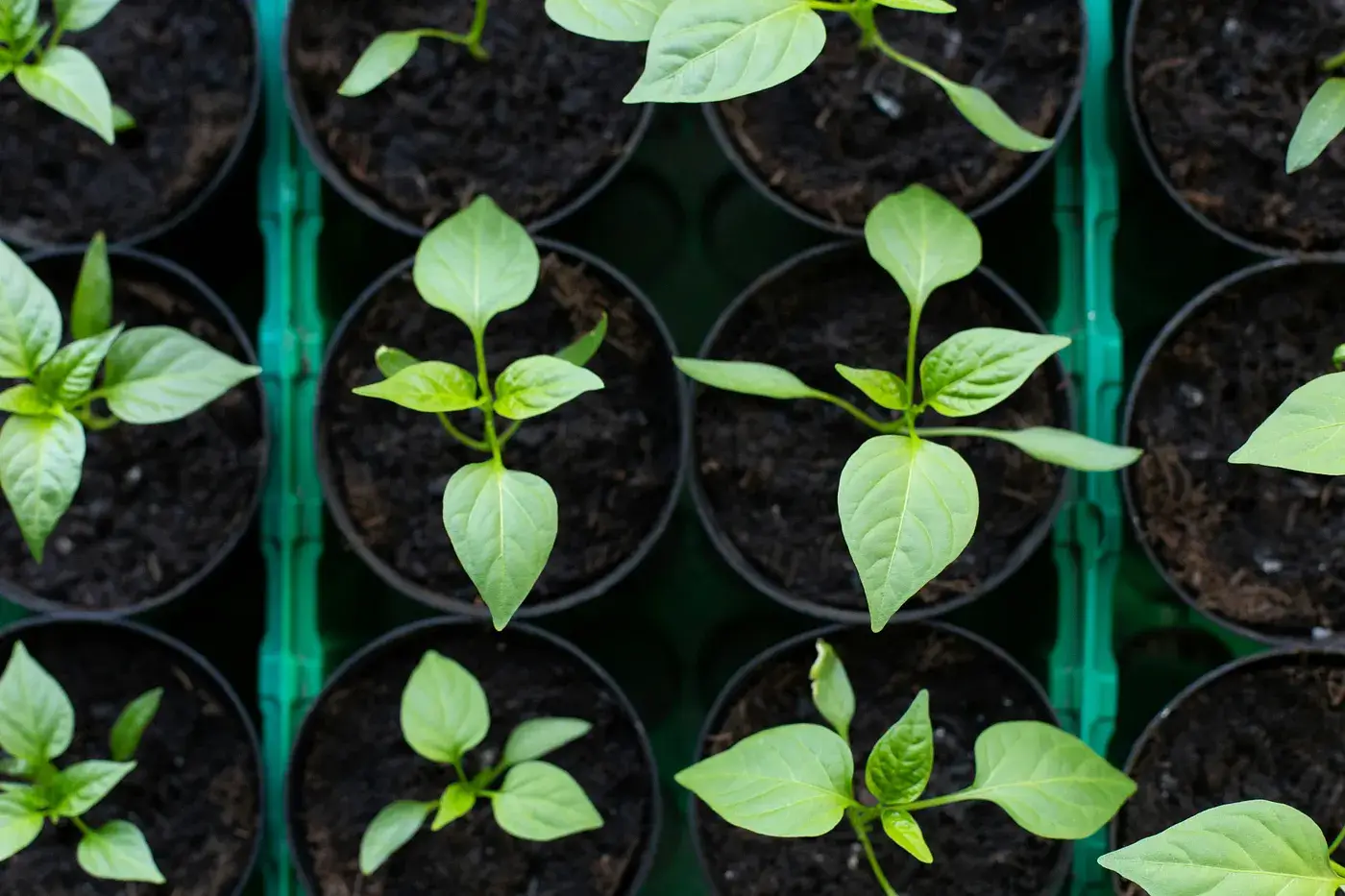
hexafarms combines sensing hardware, computer vision, AI, and software to help growers understand their crops and make better production decisions.
Food production is becoming an information problem
By 2050, the world will need to feed close to 10 billion people while agriculture faces a less predictable climate, pressure on land and water, and a constrained workforce. Retailers also expect reliable, high-quality produce year-round. Growers must therefore produce more with fewer resources and under greater uncertainty.
Growers make hundreds of daily decisions that determine yield, quality and profitability: when to harvest, how much labour to schedule, when to irrigate, whether to intervene against disease. These depend on complex interactions between plant biology, climate, labour and demand that no human can continuously process at once.
Yet, much of commercial horticulture (the production of high-value crops such as fruits and vegetables) remains surprisingly analogue. People walk through rows of plants, inspect a small sample, count and measure what they see, and extrapolate from those plants to thousands of others. Decisions, therefore, still rely on limited observations, spreadsheets, experience, and intuition.
We believe the next generation of food production will be built around systems that continuously observe crops, understand what is happening, and help growers decide what to do next. Agriculture is beginning to get an operating system.
From forecasting to an operating system
Hexafarms started with one of the highest-value decisions in crop production: knowing how much can be harvested, and when. Accurate forecasts allow growers to match production with retailer orders, labour and logistics — avoiding unsold produce, emergency purchases, misallocated labour, and missed sales.
But Hexafarms is already much more than forecasting. Forecasting remains the common foundation across its customer base, while customers are increasingly adding Crop Registration and Sensing. Cameras and sensors continuously observe plants and their environment; AI analyses their development, and software translates those observations into operational recommendations. Plant-health and pest-and-disease applications build on the same infrastructure, while the first autonomous robots are being tested to extend sensing and computer vision across the greenhouse and beyond into the open field. In this way, Hexafarms is progressively moving from visibility and prediction towards optimisation.
Why the integrated approach matters
Many AgTech companies address individual layers — sensors, robotics, AI or workflow software. We believe the harder and more valuable task is integrating them.
This integrated architecture is a central reason we invested. Hexafarms combines low-cost proprietary cameras and sensors, computer vision, machine learning, crop science, and a digital system of record — the central source of truth for greenhouse operations. It creates a flywheel: proprietary sensing creates data; better data improves AI; better AI increases software value; adoption generates more data.
Ultimately, Hexafarms aims to use this integrated data and intelligence layer to optimise production continuously, with the ambition of increasing yields by up to 30%.
Greenhouses first, not Greenhouses only
In greenhouses, high-value crops, dense production, and controlled environments make the economics of better decisions immediately visible. Small improvements in yield, timing, labour efficiency or crop loss can create substantial value per hectare.
Greenhouses are the ideal learning environment, but not the ceiling. The same challenge exists wherever high-value crops are grown: observe the plant, understand its development, predict what happens next and optimise the intervention. As sensing and robotics improve, the architecture can move into foil tunnels and, over time, open-field high-value agriculture.
Today, this begins with roughly 3.7 million hectares of greenhouse production outside China, before expanding into a larger protected-cultivation market and ultimately tens of millions of hectares of high-value crops.
Better decisions create compounding impact
Roughly one third of all food produced globally is lost or wasted (UN Food and Agriculture Organization, FAO). The impact of Hexafarms is broader than any single feature. Better forecasting reduces food waste by aligning harvest with demand. Crop registration and sensing reduce manual work and free scarce expertise for higher-value decisions.
Press enter or click to view image in full size
Earlier detection of stress or disease can reduce crop losses and enable more targeted interventions. Better optimisation can lower water, energy, fertiliser and other inputs while increasing output from existing land. These effects compound. Producing more reliably with less water, fewer inputs and less waste improves economics and environmental performance. Higher productivity reduces pressure on land; more predictable production strengthens food security; and scarce skilled labour is used more effectively.
Ambition matched by execution
With comparatively little capital, David Ahmed and his team at Hexafarms have built sensing hardware, computer-vision and AI capabilities, a growing software platform and won the trust of more than 40 commercial growers across multiple countries.
That commercial proof matters in a sector rightly sceptical of new technology. Growers adopt products when they improve the business. Customers have expanded hectare coverage, moved from forecasting into additional applications, and speak highly of Hexafarms — including within their grower communities and cooperatives.
Why we invested
At Ananda, we look for companies that address systemic societal and environmental challenges while building businesses of exceptional scale. As part of our research-driven approach, we reviewed dozens of companies across the topic of food production. Hexafarms stood out not only for its integrated technology stack and commercial traction, but also for the clarity and ambition of its vision: to build a system that can ultimately become the system of record for the growers and extend beyond controlled environments into much larger parts of high-value crop production.
We invested in Hexafarms because we believe the team has the architecture, ambition, and execution speed to build such a system. Agriculture will still depend on better machinery, crop protection, and genetics (that is why we have also invested in Soilytix). But it will increasingly depend on a new layer as well: one that turns data into better decisions. We believe Hexafarms can become the operating system for high-value crop production — enabling a food system that produces more with fewer resources, wastes less, and becomes more resilient for everyone.