Software transformed industries once information became digital. Biology is beginning to transform healthcare, manufacturing, agriculture and environmental management as biological information becomes measurable, programmable and actionable. The result is a new generation of companies that treat biology not as something to observe from a distance, but as a system they can measure, model and improve.
We call this decoding biology for impact: using breakthroughs in genetic sequencing, molecular diagnostics, robotics and AI to make previously invisible biological information visible. Then using that information to solve hard, practical problems in environmental protection, industrial production and human health.
Why Now
Three technologies have reached an inflection point simultaneously.
First, the cost of reading biology has collapsed. Just as Moore’s Law transformed computing by making computation exponentially cheaper, the collapse in sequencing costs is transforming biology by making biological information exponentially cheaper to generate. DNA, RNA and single-cell sequencing that once took years and billions of dollars can now be performed in hours. This makes biological data commercially accessible rather than confined to research laboratories.
Second, robotics has industrialised experimentation. Automated laboratories can now generate thousands of experiments in parallel. This will dramatically increase both the speed and scale of biological discovery.
Third, AI is turning these expanding datasets into predictive engines. Rather than testing every hypothesis experimentally, companies can increasingly model biological systems before entering the laboratory.
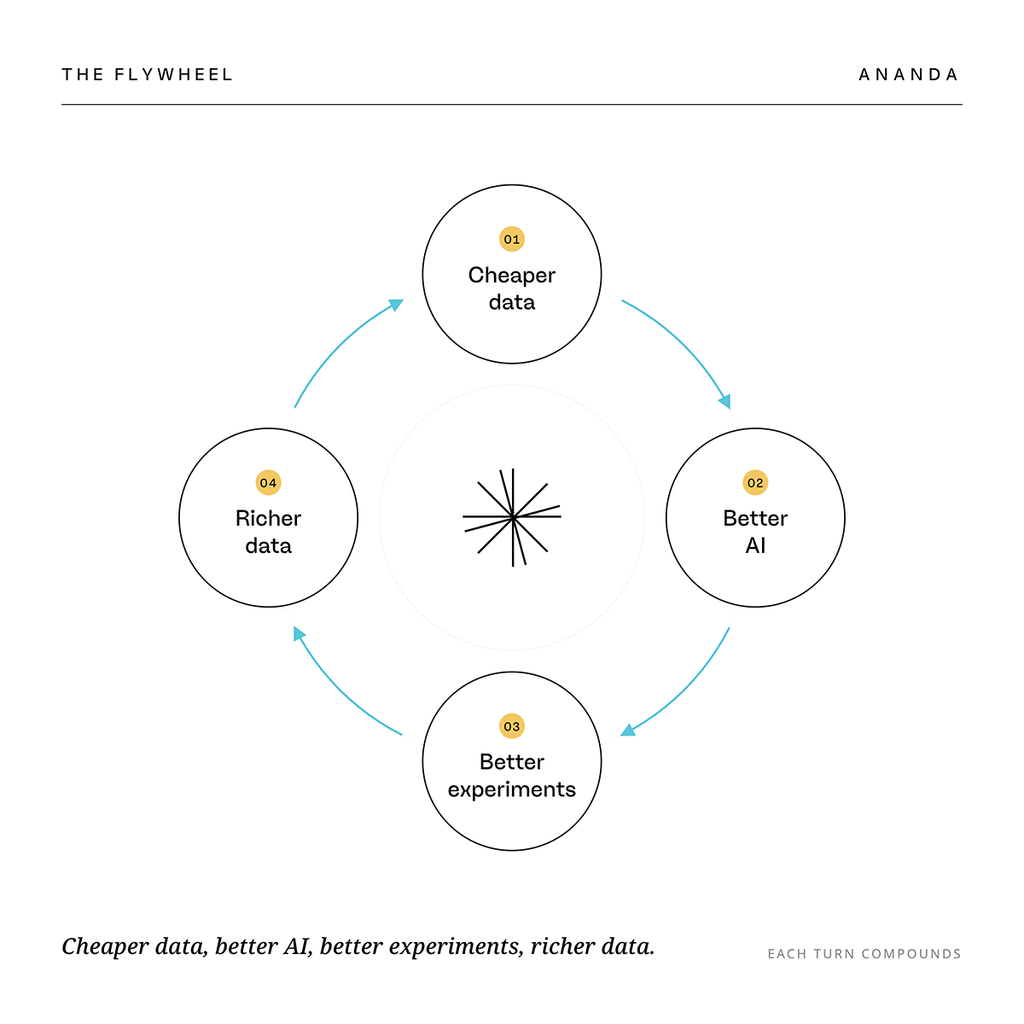
Together, these technologies create a self-reinforcing flywheel: cheaper biological data enables better AI models, which design better experiments, generating even richer datasets. Biology is becoming an engineering discipline rather than a purely observational science.
Individually, none of these shifts is new. Together, they’re changing what’s economically possible, and they’re showing up directly in the companies we’ve backed.
Decoding Biology for Environmental Monitoring
The starting point for protecting anything is measuring it accurately, and for most of the natural world we’ve never been able to do that at scale.
NatureMetrics uses environmental DNA, the genetic material every organism sheds into water, soil and air to detect and monitor biodiversity across an ecosystem without ever having to see or catch a single animal. What used to require expert field surveys and months of manual species identification is now a lab process that gives businesses, governments and conservation groups a comprehensive, auditable picture of the species present at a site. As biodiversity disclosure and nature-related regulation become increasingly important, this transforms biodiversity data from a research exercise into critical environmental infrastructure. NatureMetrics is now the global category leader in NatureData and includes Al Gore’s Just Climate amongst their investor base. They serve more than 600 organisations across 116 countries, and have mapped over 10% of the planet using eDNA, and they were recognised as a 2024 Earthshot Prize Finalist.
Just as genomes reveal human health, environmental DNA reveals the health of our ecosystems. Resistomap applies molecular sequencing to monitor antimicrobial resistance (AMR), tracking resistance genes across wastewater, agriculture, food systems and the environment before they emerge as clinical threats. Resistomap’s molecular testing quantifies resistance genes in these environmental samples, giving hospitals, national security depts, utilities and food supply chain companies an early-warning system for a problem the World Health Organization has flagged as one of the biggest threats to global health. Severn Trent in the UK and Resistomap are collaborating on “Smoke in the Water: Uncovering Public Health Data in Sewers,” a £2 million 12-month pilot project in Leicester funded by Ofwat.
Decoding Biology to Build Better Industrial Inputs
The same genetic and molecular tools that let us monitor ecosystems can also be turned inward, toward designing the biological inputs that industry runs on. Mycolever is decoding the genetic and metabolic potential of fungi to discover new biocompounds for personal care, home care and food applications, ingredients designed to outperform petrochemical, animal- and plant-based alternatives without the environmental cost of the incumbents. Rather than searching for useful compounds the old-fashioned way, one candidate at a time, Mycolever pairs computational discovery tools with a fermentation platform that can develop and scale what it finds. Mycolever has partnered with leading cosmetics formulators and is actively commercialising its bioingredients with industry partners, showcasing its platform at in-cosmetics Global, the world’s largest cosmetics ingredients event.
Differential Bio is solving an adjacent problem: once you’ve found a promising microbial strain, how do you scale its production reliably? Traditional bioprocess development relies on expensive, slow, large-scale fermentation runs to tune the dozens of variables; nutrients, temperature, timing > that determine whether a microorganism grows efficiently. Differential Bio replaces much of that trial and error with robotic lab automation that generates data at micro-scale, and AI models trained on that data that predict how a process will behave before it’s ever run at full scale. Finding the right microbial strain is only half the challenge; scaling it economically is often what determines whether a product reaches the market. Differential Bio combines robotic laboratory automation with AI to optimise fermentation processes, replacing months of experimental trial-and-error with predictive bioprocess development. By generating high-quality experimental data at microscale and using AI to model industrial performance, the company enables biomanufacturers to reach commercial production faster and with significantly lower development risk. That combination de-risks scale-up for the biomanufacturers building the next generation of sustainable materials, ingredients and chemicals. Differential Bio is already working with industrial biomanufacturing companies across sustainable materials, chemicals and food ingredients, and was selected among the Falling Walls Venture Top 100 Science Start-ups 2026.
Decoding Biology in Human Health
The same resolution that lets us identify a single species from a water sample, or model a single microbial strain’s behavior, is now reaching into human biology itself. Understanding disease begins with understanding how human cells function. Entelo Bio is building a next-generation platform for decoding human resilience by measuring gene regulation at the isoform level, revealing biological signals that conventional sequencing misses. Initially focused on musculoskeletal health and healthy ageing, the company is developing biomarkers and therapeutic insights that could transform how diseases associated with muscle decline and physical resilience are diagnosed, monitored and treated. Rather than studying disease alone, Entelo aims to understand why some individuals maintain muscle function and resilience throughout life, creating a new foundation for precision medicine in ageing and chronic disease. Entelo Bio is already collaborating with Myomar Molecular to validate novel biomarkers for muscle function as scalable clinical endpoints, positioning its platform at the intersection of precision medicine, drug development and healthy longevity.
What This Means for Where We Invest
Across environmental monitoring, industrial biomanufacturing and human health, we see the same pattern emerging: biology is becoming an information technology. As the cost of sequencing, lab automation and computing continues to fall, the ability to generate, interpret and act on biological data is creating entirely new markets. The founders we back are not simply applying AI to biology; they are building the infrastructure that makes biological systems measurable, predictable and ultimately engineerable. Whether measuring biodiversity from a water sample, optimising industrial fermentation, or decoding human resilience at the molecular level, each company transforms previously inaccessible biological information into actionable decisions for customers.
For us, the opportunity extends beyond any single application. The most valuable companies will be those that build proprietary biological datasets that compound over time, improving models, products and customer outcomes with every experiment, every sample and every patient. These data assets become durable competitive advantages while enabling measurable environmental and human impact.
At Ananda, we believe this convergence of biology, AI and automation represents one of the defining technology shifts of the coming decade. The founders building this infrastructure today are not only creating category-leading companies, they are laying the foundations for an economy that can finally understand, optimise and work with the biological systems on which it depends.
If you’re building the next generation of biology’s infrastructure, we’d love to hear from you.
Article by Zoe Peden and Chloe Lambert, Ananda Impact Ventures