Aitiologic combines a proprietary assay, long-read sequencing and AI to identify which organ in the body each fragment of DNA in a blood sample came from. Applied to the routine pregnancy blood test, that lets clinicians see complications developing in the mother months before they appear. Preeclampsia is where it starts.
Maternal health is a field precision medicine has not reached
In 1997 Dennis Lo discovered that the placenta sheds DNA into the mother’s bloodstream. That single observation built the non-invasive prenatal testing (NIPT) industry: millions of samples a year, reimbursed across most developed systems. Nearly thirty years on, it remains focused solely on the health of the fetus. The same tube holds far more. Cells across the body die and turn over constantly, and each one sheds DNA into the blood as it goes. Read those fragments properly and you can see which organs are under strain, months before symptoms appear.

Oncology went molecular, fetal health went molecular. The mother did not. Women spend 25% more of their lives in poor health than men, yet roughly 1% of healthcare research and innovation goes to female-specific conditions outside oncology.
Tissue of origin is the hard problem
Aitiologic asks a different question of the same tube. Not only the baby’s chromosomes, but which organ each fragment of DNA came from. That is far harder than it sounds since blood is a mixture. DNA arrives from the placenta, the mother’s blood vessels, her immune system and her liver all at once, and none of it comes labelled. Working backwards from the mixture to its sources is a problem very few teams anywhere can solve.
Three things had to work together. First, an assay that keeps the molecule intact. The clues to a fragment’s origin are physical: how long it is, where it broke, and the chemical marks known as methylation that cells attach to their own DNA, which differ from one organ to another. Conventional sequencing copies and chops the DNA before reading it, which erases most of them. Long-read sequencing reads the molecule as it is, so they survive. Second, a model that reads those layers off the same molecule, because the signal lies in the combination rather than in any one of them. Third, training data pairing first-trimester blood with matched tissue and confirmed outcomes, through the Fetal Medicine Foundation and King’s College.
All three at once is the hard part. It is also why this is possible now and was not five years ago: long-read sequencing has only recently become good enough, and cheap enough, for clinical use.
Preeclampsia is the beachhead
Preeclampsia is a complication in which a mother’s blood pressure rises and her organs begin to fail. There is no cure but to deliver the baby, so prevention has to start early. It affects roughly one in twenty pregnancies, claims the lives of around 76,000 mothers and 500,000 babies every year, and US rates have roughly doubled since 2007 as obesity, chronic hypertension and maternal age all rise.
Intervention works if you know who to treat. Aspirin cuts preterm disease by around 60%, planned delivery cuts term disease by 30%. Prediction is the bottleneck. Today’s standard test needs expert Doppler ultrasound and a specialist appointment, so it has never reached scale. Aitios needs neither, because it runs on a blood sample that is already being taken.
It is also the ideal first proof of the technology. Preeclampsia is really two diseases (preterm and term), and tissue resolution tells them apart. Preterm disease is placenta-driven, term disease carries a stronger signal from the mother’s own vasculature and immune system. Nobody told the model to look for that, and it matches what clinicians had concluded independently. Current screening cannot make the distinction, which is why term disease, four times the more common form, is so badly predicted today. In a study with the Fetal Medicine Foundation, now out as a preprint, Aitios beat the current standard on preterm disease and beat it by a wide margin on term. A 1,000-sample blinded validation with the same partners reports interim results at the end of 2026.
One platform, many indications
Tissue attribution is a platform capability. A new indication needs no new infrastructure: the same sample, the same assay, the same lab workflow. What it needs is clinical evidence. Gestational diabetes is already in the validation study, gestational hypertension follows, and fetal growth restriction is within reach. None of it asks anything new of the patient. She gives the same blood sample she would have given anyway for her baby, and gets her own screening results alongside the fetal ones.
The capability is not limited to pregnancy. Lo’s insight came from oncology, where tissue of origin is still the unsolved half of early detection. Immunology is a natural fit too, since the same reading shows which organ is inflamed. So is drug development, where it turns a blood draw into an organ-level safety readout. This is not the plan for the next three years, but both are why the ceiling is high.

A team few could assemble
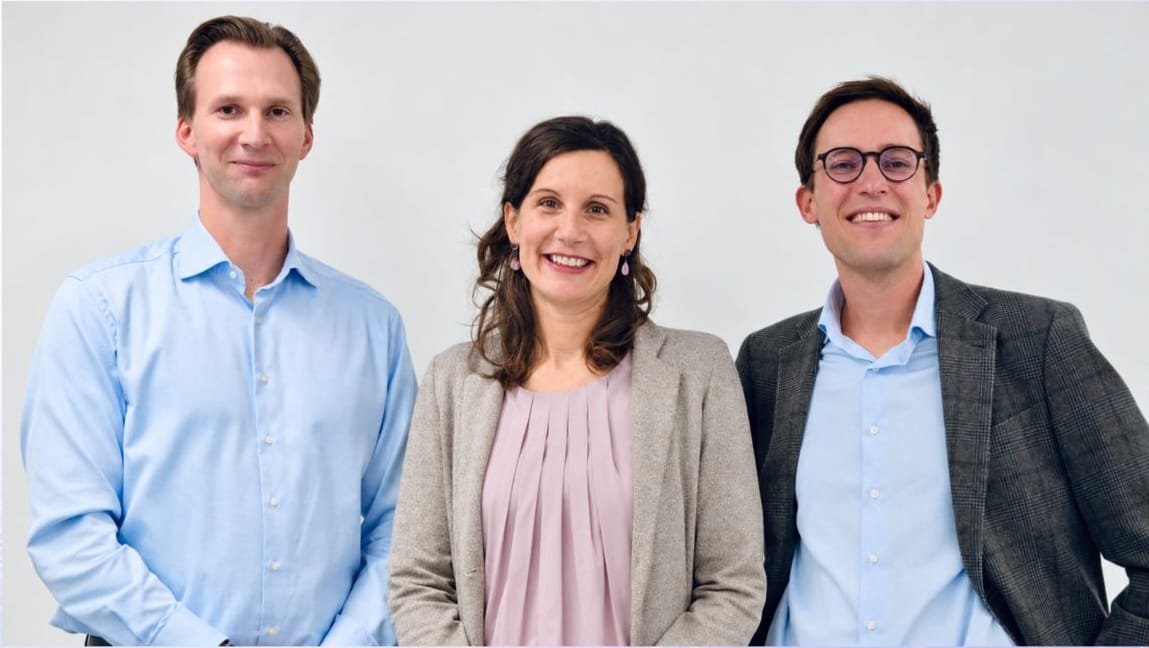
Andreas Posch invented the method at Siemens Healthineers, then built and sold a company applying AI and DNA sequencing to infectious disease. CTO Stephan Beisken brings 15 years of genomics machine learning. CMO Rebecca Ertl, a Nicolaides fellow who founded Vienna’s largest prenatal diagnostics centre, had the original idea to point cell-free DNA at preeclampsia.
Two things persuaded us. First, the pace. Since coming out of stealth in late 2024 they have published with the Fetal Medicine Foundation, secured a 1,000-sample validation cohort with King’s College, established a relationship with Oxford Nanopore and joined Eli Lilly’s Gateway Labs as the only participant not developing a drug. All on roughly €3.5 million.
Second, the people around them. Gordon Sanghera, co-founder and CEO of Oxford Nanopore until this year, advises the company and invested personally. Professor Kypros Nicolaides, the godfather of modern fetal medicine, wrote the risk score Aitios is measured against and supplied the validation samples. He takes no equity and no advisory seat, and publishes whatever the data show. Letting a rival method be measured against his own benchmark is worth more than any endorsement.
Why we invested
At Ananda, we look for companies that address systemic societal challenges while building businesses of exceptional scale. Our research into precision medicine kept surfacing the same pattern. Whole areas of medicine are still waiting for it, in pregnancy it stops at the fetus. The mother gives the sample and learns nothing from it.
Aitiologic can read the other half. The technology is genuinely hard. The dataset behind it is close to unrepeatable. The channel to patients already exists, because the sample is already being taken. It is one of the first convincing clinical uses of long-read sequencing, a capability that will find applications well beyond pregnancy.
We invested because we believe this team can turn one routine blood draw into a molecular readout of maternal health, and give every mother the warning her baby already gets.